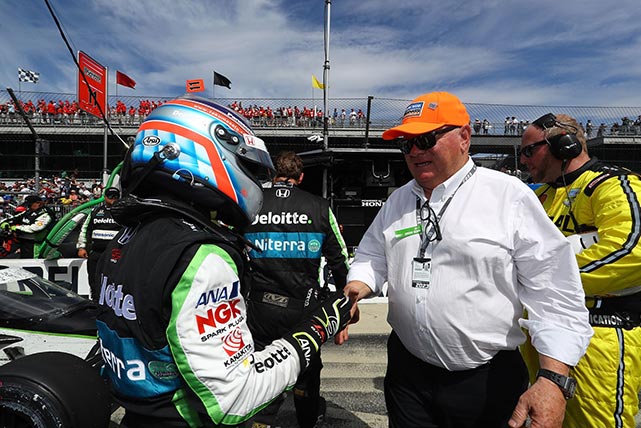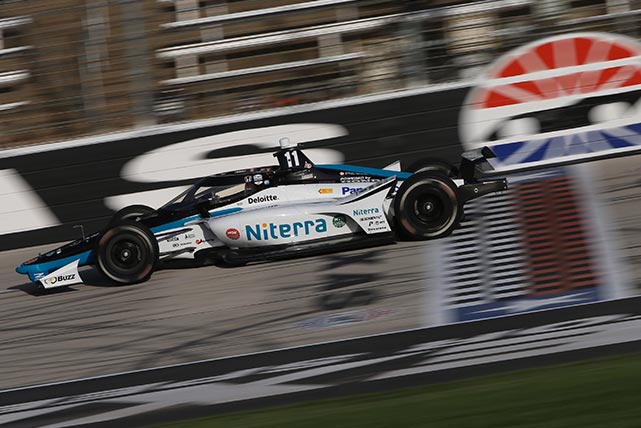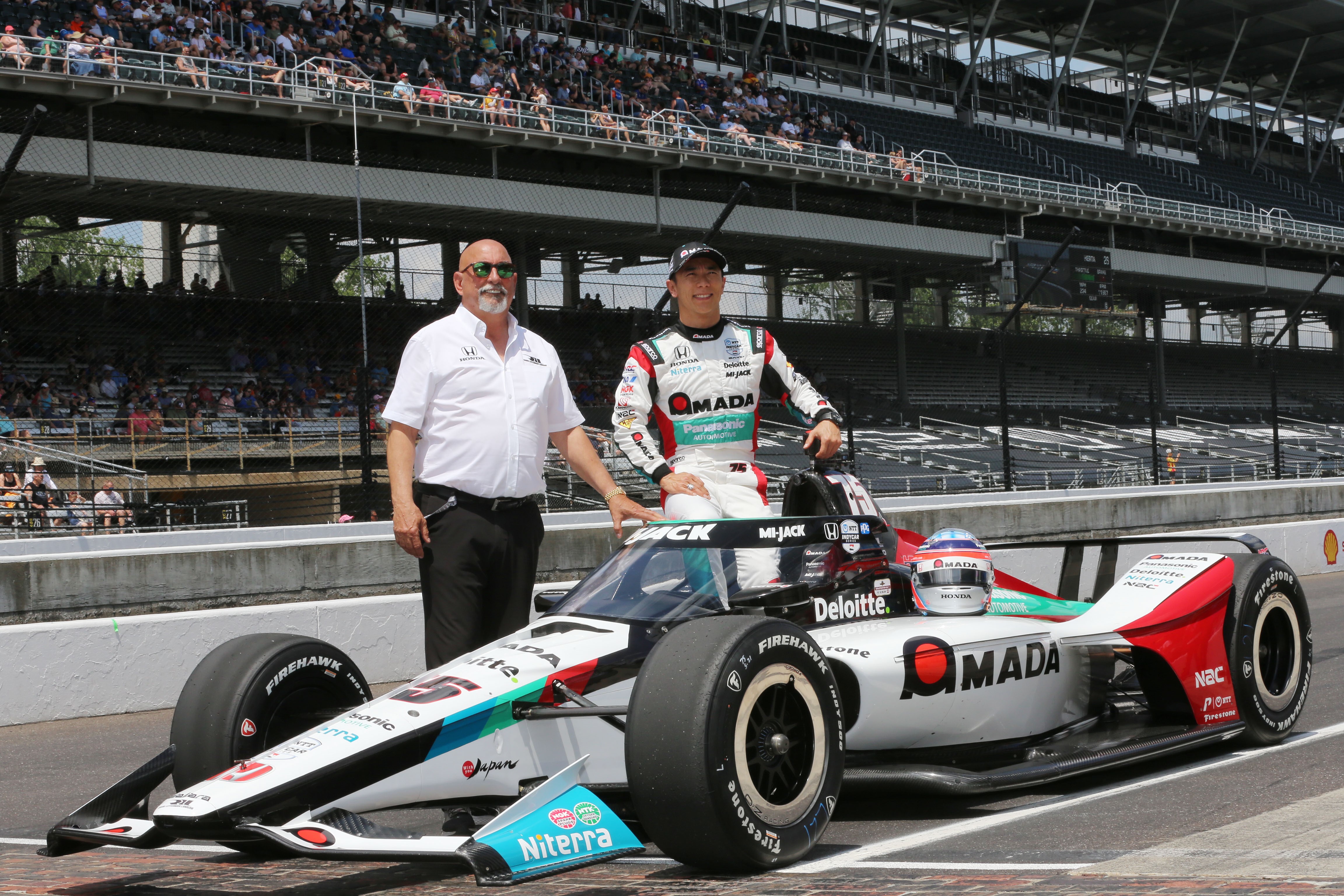
| ■Nationality Japanese | ■Date of Birth 28 January 1977 | ■Place of Birth Tokyo |
| ■Height 1.64 m | Weight 59kg | ■Hobbies Cycling and food |
2010
After coming close to securing a Formula 1 drive with at least one team for 2009, Sato was to be disappointed and instead set his sights on an alternative career, joining many of his old racing friends and rivals from Europe in the IZOD IndyCar Series for 2010.
▲Sato’s challenging Indycar debut with KV Racing
2011
Since moving to the States he has continued his association with engine supplier Honda, firstly by driving for the KV Racing Technology team of Kevin Kalkhoven and 1996 champion Jimmy Vasser during the 2010 and ’11 seasons.
▲Mid-Ohio: Finished in 4th position,a long-overdue result
Taku proved instantly fast on all forms of track in the USA - street circuits, road courses and ovals - but during these first two years luck just did not go his way. His best finish with KV was a fourth at Mid-Ohio in 2011, small reward for someone who was fast enough to take two pole positions, on the Iowa oval and on the airport layout of Edmonton. Just when it looked as though victory was in his hands at a soaking wet Sao Paulo, a fuel-strategy gamble backfired, and it would prove a long and frustrating wait to finally score an IndyCar win. As well as Sao Paulo, he led three other races in 2011.
2012
His wait would endure throughout 2012, for which he joined the Rahal Letterman Lanigan Racing team run by 1986, ’87 and ’92 Indycar champion Bobby Rahal.
At RLLR he renewed his association with his friend Gerry Hughes, who engineered Sato at the Super Aguri F1 team. Once again the speed was there, even though there were no pole positions. Many times Taku made progress up the field in races, most notably in the Indianapolis 500, when he made a daring dive for victory on the final lap only to be forced into a spin - and the wall - when Dario Franchitti squeezed him low at Turn 1.
▲Edmonton: Sato earned his best series finish of 2nd place
A strong race at Edmonton saw Sato finish a close second to Helio Castroneves, and he led five races during the season. At the end of the year he also returned to Asia to contest some Formula Nippon races in Japan with Team Mugen and two rounds of the FIA World Endurance Championship - at Shanghai and Fuji - with OAK Racing.
▲Sugo, Formula Nippon: Sato participated in Formula Nippon with Team Mugen
2013
In 2013,Taku teamed with AJ Foyt Racing. That meant that Taku lined up with the legendary #14 made famous by Texan team boss Foyt, who as a driver won seven Indycar titles, four Indy 500s and even the 24-hour races at Le Mans and Daytona.
Sato combined well with veteran IndyCar engineer Don Halliday, showing fantasticrace pace that finally netted him his breakthrough win at Long Beach in April. In the next round he was on the verge of doing it again at Sao Paulo, but on fading tyres he was forced to concede the lead at the very last corner of the final lap. Still, second place promoted him to the series lead heading to the Indy 500.
An unfortunate run of mid-season results blunted his title challenge but a pole position in the Houston round in October Sato’s first since 2011 showed that things could have been much better. Taku also again contested a limited programme with Team Mugen in Japan in Super Formula, the renamed ex-Nippon series.
▲Long Beach:Sato became the first Japanese driver to win an IZOD IndyCar Series race
2014
For 2014, he remains with AJ Foyt Racing, and driver and team plan to use the stability this brings to challenge at the front of the IndyCar field again, and hopefully return to the highest reaches of the points table in what is set to be a thrilling and competitive season.
Although he managed to gain two pole positions, he was not able to win any races or get on the podium. There were just two top-five finishes, with a best result of fourth. It has to be acknowledged that the overall performance was much lower than in 2013, the year he scored his first win in IndyCar. But, as the relationship strengthens with AJ Foyt Racing and his engineering team, Sato’s feelings are very positive.
▲St.Petersburg: Sato’s fourth pole position of his career with quickest in all three rounds of qualifying.
A push in development during the off-season had led to Taku being upbeat for the new season, thanks to better car set-ups. But the rapid development throughout the field led to the team dropping down the order, a phenomenon that seems to have struck ever since he first took part in IndyCar in 2010.
But Sato and AJ Foyt Racing worked hard. Even though the team ran with just one car, the squad’s flexibility and aggressive development style led to steady progress, and the momentum improved throughout the 2014 season. Both top-five results came towards the end of the season in Toronto and Sonoma and he was able to finish sixth in the final race on the Fontana oval.
▲Detroit Race 2: Sato’s 2nd pole of the 2014 season
2015
Acknowledging the enthusiasm, technical skills and racing performance of Taku, AJ Foyt announced on November 1 that he was going to extend the Japanese driver’s contract for the 2015 season, and that he would increase the team’s staff and shift to a two-car line-up.
This news represents a big boost for Sato and his team, giving them the opportunity to further speed up development beyond what would be possible with just one car. Additionally, new rules for 2015 permit the use of an aerodynamic kit developed by the engine manufacturer, giving the team the chance to minimise the distance to the top teams. With this in mind, Taku and AJ Foyt Racing were looking towards a bright future in 2015.
For 2014 he remained with AJ Foyt Racing, and driver and team planned to use this stability to challenge at the front of the IndyCar field again. Although he managed to gain two pole positions, he was not able to win any races or get on the podium. There were just two top-five finishes, with a best result of fourth. It has to be acknowledged that the overall performance was much lower than in 2013, the year he scored his first win in IndyCar. But, as the relationship strengthened with AJ Foyt Racing and his engineering team, Sato remained very positive.
A push in development during the off-season had led to Taku being upbeat for the new season, thanks to better car set-ups. But the rapid development throughout the field led to the team dropping down the order, a phenomenon that seems to have struck ever since he first took part in IndyCar in 2010.
But Sato and AJ Foyt Racing worked hard. Even though the team ran with just one car, the squad’s flexibility and aggressive development style led to steady progress, and the momentum improved throughout the 2014 season. Both top-five results came towards the end of the season in Toronto and Sonoma and he was able to finish sixth in the final race on the Fontana oval.
Acknowledging the enthusiasm, technical skills and racing performance of Taku, AJ Foyt announced on November 1 that he was going to extend the Japanese driver’s contract for the 2015 season, and that he would increase the team’s staff and shift to a two-car line-up with promising Englishman Jack Hawksworth joining the attack.
▲Detroit Race 2: Sato starred with a fantastic run to second position
This news represented a big boost for Sato and his team, giving them the opportunity to further speed up development beyond what would be possible with just one car. Additionally, new rules for 2015 permitted the use of an aerodynamic kit developed by the engine manufacturer, giving the team the chance to minimise the distance to the top teams.
The season started brightly, with fifth on the grid in the opening round in St Petersburg, but soon it became apparent that the Honda aerodynamic kit was not quite as competitive as that of Chevrolet. Sato and the #14 AJ Foyt Racing Dallara were the fastest Honda runners in St Pete, something that would be repeated a number of times over the season, but it was actually the superspeedway oval races where they looked strongest.
A first-lap collision meant a recovery onto the lead lap in the Indy 500; although he finished 13th, Taku was only six seconds adrift of race winner Juan Pablo Montoya. At Fontana, Sato led numerous times and was well and truly in the mix for the win when he got trapped between Scott Dixon and Will Power in the late stages and crashed out. And at Pocono the #14 car was again a leader before finishing sixth in a race marred by the tragic accident that befell Taku’s friend Justin Wilson.
Even so, his best result of the season was second place in a wild and exciting race in Detroit, and only a temporary finish to the race prevented an attack for victory that could have seen him prevail over eventual winner Sebastien Bourdais. Detroit also gave Sato his best qualifying position fourth of the season as he ended the campaign 14th in the points.
In December, AJ Foyt Racing announced that once again Taku would represent the team in 2016, his fourth season with the squad making him the driver to have spent longest in one of Foyt’s cars other than AJ himself! Once again Hawksworth joins Sato in a two-car line-up, with a restructure bringing George Klotz in as team director and Don Halliday becoming technical director to oversee the race engineers. Furthermore,with IndyCar allowing Honda an aero-development break over the winter in order to catch up Chevrolet, hopes are high for the 2016 season.
2016
Unfortunately it turned into a disappointing year, with Sato finishing 17th in the points and Hawksworth down in 20th. The season began with the prospect of some good results. Taku was one of three drivers to crash in practice for the first round on the Phoenix oval, the enormous 78g impact ruling him out of qualifying, but he had a respectable run in the race. Then, at Long Beach, he finished a very competitive fifth.
But from then on the races were tough despite glimmers of promise. The Indianapolis 500 in particular looked like being a good day for Taku, as the Foyt team adjusted the car through the race and it became increasingly competitive, only for an accident to rule him out just into the final 100 miles. There seemed to be a breakthrough on road-course form for the #14 car at Road America in June, and Sato should have finished in the top five, but an electronics glitch played havoc with the pit speed limiter, costing two drive-through penalties.
Further into the summer there was a good run to fifth at Toronto, and then Taku looked good for fourth in the closing laps at Mid-Ohio only to be knocked down the order when a passing attempt by Sebastien Bourdais went wrong. Third on the grid at the Pocono superspeedway preceded a trip into the wall in the race when a sudden aero-instability problem struck, and the gloom deepened at Texas Motor Speedway, a race for which he had qualified fourth but ended when the car was parked due to a severe handling imbalance.
▲Toronto: Sato chasing up the lap leader, Max Chilton
IndyCar’s return to Watkins Glen featured a storm up the order by Sato, only for a late spin to deprive him of a possible top-six finish, and he ended the season with 14th at Sonoma.
That turned out to be his final race in the #14 car. In December it was announced that Taku would join Andretti Autosport for 2017, his eighth season in IndyCar competition. Remarkably, it means that Sato will now have driven for four different IndyCar champions during his career in the States first Jimmy Vasser, then Bobby Rahal, then AJ Foyt and now Michael Andretti! More significantly, it will be the first time that he has been part of a multi-car line-up. Joining Ryan Hunter-Reay, Marco Andretti and Alexander Rossi in the Honda-powered Andretti team means that he now has the environment in which to progress far more rapidly across a race weekend and hopefully secure some top race results in 2017.
2017
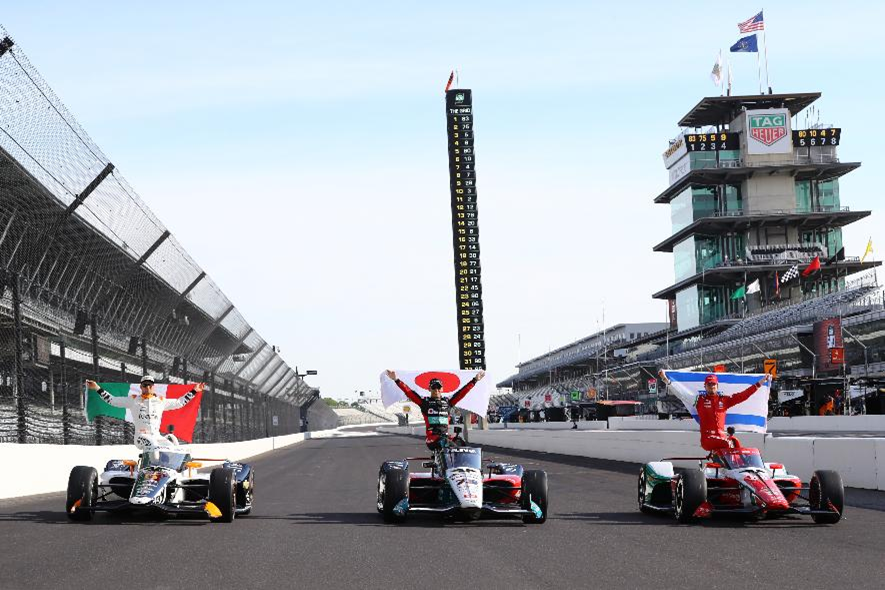
Indianapolis 500 race winner! Sato scored a stunning win in the 500, putting the #26 Andretti Autosport Dallara-Honda in Victory Lane and becoming the first driver from Asia to do so – as well as becoming the first Japanese ever to win such a prestigious race in open-wheel competition.
▲Indy500: Sato became the first Japanese to win Indy 500
At Andretti, Sato reunited with Garrett Mothersead, previously his engineer during his KV Racing days in 2010 and ’11. The relationship resumed well, with Taku finishing fifth at St Petersburg, and only losing fourth to Andretti team-mate Ryan Hunter-Reay due to a push-to-pass glitch coming out of the final turn of the race. Results took a dive after this, but form improved hugely on the Indianapolis Motor Speedway: Sato was competitive all through the Month of May, qualifying fourth. The race was a thriller, as he bounced back from a wheelnut getting away during a pit stop, this dropping him to 17th place. Undeterred, he climbed back through the field and pipped Helio Castroneves in a dramatic finish.
This propelled Taku into title contention, and he stayed there thanks to a competitive weekend at Detroit Belle Isle. Here he took a pole position and finished the twin races eighth and fourth, losing a top position in the first thanks to getting wrongfooted on strategy. Next time out at Texas Motor Speedway, a crash in the closing stages with Scott Dixon as they vied with Will Power for the lead left Sato classified 10th, but still in with a shot of the IndyCar crown.
That faded away during the summer, a pinched nerve in his neck hampering him at Road America, and problems striking in subsequent races. But good form in August netted Taku fifth place at Mid-Ohio, and then a pole at the Pocono superspeedway, only for aero issues to slow him in the race. The season ended with more misfortune, but Sato finished a career-best eighth in the points, and also he tied Dixon for being the top Honda qualifier on most occasions: six apiece.
▲Pocono: Sato won the 2nd pole position for 2017 season after Detroit.
Off-track there was a lot going on too. In California for the Long Beach race in April, Sato launched his limited-edition TS Wine. Then, after Indy 500 victory, came an exhausting but rewarding whirlwind tour of media commitments, which even caused him to miss out on some pre-race testing. In August, Taku became only the 33rd person in history to receive Japan’s Prime Minister’s Award, from Shinzo Abe himself. In short, it was an unforgettable year!
Finally came confirmation that the one-year association with Andretti Autosport was at an end. For 2018, Sato rejoins Rahal Letterman Lanigan Racing, which is expanding to a full-time two-car line-up of Honda-powered cars, with Graham Rahal – sixth in the 2017 points – alongside. It promises to be an exciting year with a very highly regarded team and in the first season of the revised IndyCar chassis.
2018
Back with Rahal Letterman Lanigan Racing, it was a typically dramatic IndyCar season for Sato, with some good performances undermined by bad luck. But at the penultimate round, he became a race winner for the third time in his IndyCar career as the series returned to the Portland road course. This up-and-down campaign gave him 12th position in the final points.
It began at St Petersburg with a very competitive showing, Taku looking strong for a top-five finish until he was taken out by Scott Dixon in a rare mistake from the man who would go on to win the title. After scoring 11th on the Phoenix oval, Sato was racing onto the verge of a podium finish on the streets of Long Beach before he unavoidably made contact with a spinning Ryan Hunter-Reay.
A bizarre race at Barber Motorsports Park was rained off after several laps on Sunday and restarted on Monday, with Taku finishing eighth. Then an eventful Indy GP started with Sato being taken off by Spencer Pigot, recovering up the order, plummeting down the field again when his left and right-side tyres were mistakenly alternated, and charging back from 20th to claim 10th spot. That was as good as Indy got, because in the following 500, as the defending winner he crashed out early in the race when he caught the slowing car of James Davison in the middle of a corner.
Some good results followed: fifth at Detroit Belle Isle, seventh at Texas Motor Speedway and fourth at Road America, where he could have beaten Dixon to third had he not been run off the road by Alexander Rossi. Then there was a superb third at Iowa Speedway, despite a brush with Ed Carpenter.
▲Iowa: First podium finish for the season. Enjoying a slice of pizza provided by the sponsor on the podium.
At Toronto, Sato was running in the leading group of three, but lost momentum and dropped to eighth when Josef Newgarden hit the wall in front of him. He was back up to fifth when he replicated Newgarden’s error, forcing him out. Strong pace at Mid-Ohio was ruined when Max Chilton spun Taku round in the early stages. And Pocono had hardly got going when Robert Wickens had his dreadful crash, James Hinchcliffe hitting Taku in the chain reaction and forcing them both out.
The #30 RLLR machine was off the pace at Gateway, but inspired strategy had Sato in contention for the win before an ill-timed yellow forced him to settle for ninth. But at Portland all came right. As at Long Beach, Taku used a counterintuitive low-downforce set-up plus a brave strategy to race up the field, and the set-up would make him difficult to pass for those on normal strategies. When he beat Hunter-Reay off pitlane in a late round of stops, that set up a famous victory – Sato’s first on a road course in IndyCar. The season finished with engine failure at Sonoma, when he looked likely to finish in the top six.
▲Portland: Sato’s third series win and first win with RLLR.
2019
Sato looked like having his best IndyCar season yet with Rahal Letterman Lanigan Racing, and was holding down fourth or fifth position in the points during the late-spring and early-summer races. But then an almost unbelievable run of bad luck began, and he slid down the table to take ninth place in the final rankings. Still, 2019 with Rahal Letterman Lanigan Racing was the first in which he took two wins, bringing his career IndyCar total to five, and he also claimed two pole positions to bring his overall score to nine.
While a gearbox problem caused by debris brought Taku’s first race of the season in St Petersburg to an end, and a broken airjack in the pits left him seventh at Circuit of The Americas, he bounced back with a masterful display at the scenic Barber Motorsports Park in Alabama. Here, Sato put the #30 RLLR Dallara-Honda on pole position and dominated the race to take victory.
▲Barber, Alabama
After eighth at Long Beach and 14th in a dramatic dry/wet Indy GP came the next highlight. Back at the Indianapolis 500, which he won in 2017, Taku was just 0.3413 seconds away from taking his second win in the legendary race, finishing in third place. That was a stunning comeback, after a cracked wheel had left him off the lead lap earlier in the race.
▲INDY500, Indianapolis
There was a further podium for third at Detroit Belle Isle, and another pole position at Texas Motor Speedway, a venue at which he was comfortably leading before an unfortunate incident in the pits, for which he earned a penalty, removed him from contention. A good result at the following Road America race was ruined when he was hit off the track early on, but he still finished 10th.
Then came a run of four races in which he only finished once. Particularly unlucky was his run at Iowa Speedway, where Sato was running in the top three before he was hit by a lapped car and later retired because of the damage. But he bounced back from this devastating run with a superb second win of the season on the Gateway oval, combining great pace from the #30 car with canny strategy. The last two races of the season featured a return to ill fortune – he was hit by other cars in both, losing any chance of hanging on to sixth in the points.
▲Gateway, Illinois
Still, the signs were there that Sato and the RLLR team are a potent force, and the deal was completed for a third consecutive season together in 2020, leaving a full winter of planning so they could race out of the blocks and contend for their best campaign yet.
2020
In his 11th season in the IndyCar Series, Takuma Sato recorded his best finish to date in the final standings with seventh position. But, more significant than that, he recorded his second Indianapolis 500 victory – his first with Rahal Letterman Lanigan Racing.
It was incredible that the season happened at all, owing to the coronavirus pandemic that impacted all sports worldwide. This was just beginning to take hold in the United States when the teams arrived for the traditional season opener at St Petersburg in March. The race was called off, the teams packed up, and the campaign did not get under way until June, at Texas Motor Speedway.
The effect of the virus also meant a lot of double-header races, plus condensed race-weekend schedules, and this bit Sato in Texas when he crashed going into his qualifying run, and there was insufficient time for the #30 Dallara-Honda to be rebuilt for the race. He would have to wait until July, for the Indy GP, for his season to start.
The opening trio of road-course races brought three top-10 finishes. Taku was 10th at Indianapolis, despite a breakage in the rear suspension, and then fought back from being pushed off at the start at Road America, plus a refuelling problem, to finish ninth. In the second race of the Road America double-header, he improved to eighth.
▲Road America
An inspired strategy at Iowa Speedway allowed Sato to lead for 50 laps following an early first pitstop, and he was looking likely to win until an ill-timed caution completely ruined the RLLR team’s tactics, relegating him to 10th at the finish.
Still, that oval pace was carried over to the Indianapolis 500, where the #30 was consistently one of the quickest cars throughout the two weeks of practice and qualifying. Sato put the car third on the grid, and survived a collision in the pit lane when Alexander Rossi bumped into him to remain in the leading positions throughout. The race boiled down a battle between Taku and Scott Dixon, and the Japanese was in front when a late caution was called to give him an emotional win in the 500, which had been delayed until August by the pandemic.
▲Indianapolis 500: Sato earned his best start for the Indy 500 of third place.
▲Sato and his team members taking selfies in the victory circle.
The St Louis oval followed hard on the heels of the 500, and Sato returned from his intensive post-Indy media commitments to look very likely to win the first race of the weekend. Unfortunately, a delay at his final pit stop dropped him to third. A fantastic pass on Pato O’Ward promoted Taku to second, but he could not pass Dixon for the win. From pole position, he led the second race for 59 laps, but his race was ruined by backmarkers not moving out of the way, delaying him significantly so he finished ninth.
▲St.Louis Race 1: Sato finished second by 0.14 second after thrilling duel with the winner.
Two frustrating events followed, at Mid-Ohio and back on the Indy road course, although Sato led 16 laps in the second Mid-Ohio race while off strategy. And finally the teams reconvened back at St Pete, where Taku finished 10th, although that should have been higher but for a controversial penalty.
Still, it gave Sato seventh in the points. And the season was a fine send-off for veteran RLLR engineer Eddie Jones as he headed into retirement. Sato would be back on board at the team for 2021, with a new engineer in the form of Matt Greasley who, just like Taku, learned his trade with the Carlin Formula 3 team in Europe!
▲St.Petersburg; Sato and Eddie Jones
2021
Following a strong 2020, the 2021 season was a little disappointing, with Takuma Sato taking 11th in the points with Rahal Letterman Lanigan Racing. There were no podium finishes, with a best result of fourth at Detroit Belle Isle, but strong consistency meant constant point-scoring, and the #30 only twice failed to make the end of a race.
The RLLR team struggled throughout the season in qualifying, with Sato often lacking grip through being unable to switch on the soft Firestone red tyres, but the flipside was that this translated into strong race form. Time after time he would make strong progress through the field. The oval tracks, a particular strong suit for Taku, should probably have yielded at least one win, only for problems at pit stops or strategy decisions to play against him.
▲Texas: Sato running the oval tracks with his teammate Graham Rahal
After rising from 19th on the grid to finish 13th in the opening round at Barber Motorsports Park, despite contact from Simon Pagenaud pushing him wide, Sato put in a strong drive up the order to place sixth on the streets of St Petersburg. Then came the double-header on the Texas Motor Speedway oval. An ill-timed yellow forced him back to ninth in race one, and then a wheelgun problem in the second race cost him two laps. He fought back to lead, but a decision not to stop under a yellow meant he pitted under green and finished 14th.
▲St. Petersburg: Sato drove to a sixth place finish
The #30 was 16th in the Indy GP, before Taku’s favourite event: the Indy 500 he has twice won. With good fuel mileage and strong pace, he twice led the race, but an extreme strategy in trying to save fuel and make one pit stop fewer than the rest cost him a massive amount of speed in the late stages. He finished a crestfallen 14th, having been in a position for a top result.
▲Indy 500: Sato congratulating Helio Castroneves, the 105th Indy 500 winner
Detroit was next up, and Sato rose from 16th on the grid to second on a late restart, only to run wide and drop to fourth. He was 12th the following day, before heading to Road America. Here, he recovered from an early incident that caused a flapping sidepod and damage to the floor to rise to eighth, making up four places on the final lap!
▲Road America:A word from Eddie before getting into the car
A late pass on Sebastien Bourdais for 10th was the highlight of Mid-Ohio, and then a chaotic inaugural event on the streets of Nashville ended with Taku sidelined with suspension damage as a victim of one of the inevitable chain-reaction accidents on the narrow circuit.
▲Mid-Ohio:Sato raised the position to avoid an accident on turn 3 immediately after the start
Back on the Indianapolis road course, Sato was looking good in eighth when there was a late caution and, on used red tyres, he was vulnerable to attack, late contact with Josef Newgarden forcing him briefly off track for an eventual position of 10th. Then came astonishing speed in the race on the St Louis oval. Taku was second, with leader Bourdais doomed to make an extra stop for fuel, when it became apparent that insufficient fuel had been going into the #30. A late stop under yellow consigned him to sixth.
▲St.Louis:Sato pit in at the last yellow caution
There were mixed fortunes again in the final trio of races on the West Coast. At Portland, engine failure in practice meant Sato started from the back. He was up from 27th to 12th after opening-lap chaos, but those victims of the first-lap incidents were forced onto what turned out to be beneficial strategies, and he finished 12th. At Laguna Seca, he rose as high as third, but spun at the Corkscrew and was inadvertently collected by Scott Dixon. Damage to the diffuser meant he retired in the closing laps. The season finished with a strong run to ninth at Long Beach.
▲Long Beach:It was a tough year, but it was a great crew and team
That was the end of Taku’s second period with RLLR, with an announcement of a parting of the ways coming at the end of the season. For 2022, there was a new partnership with the race-winning Dale Coyne Racing squad to look forward to.
2022
Sato’s switch to Dale Coyne Racing with RWR was accompanied by high expectations, particularly on oval tracks where driver and team had excelled in recent years. And, thanks to the Japanese’s two Indianapolis 500 victories, he was regarded as one of the favourites for honours in the Memorial Day classic. But the season resulted in a lowly 19th position in the points, way below what had been anticipated.
A bizarre incident with accident-prone ex-F1 driver Romain Grosjean on the Saturday morning of the first round of the season, in St Petersburg, set the tone for the season. The Frenchman unaccountably smashed into the back of Sato’s #51 Dallara-Honda as traffic backed up to get a clear run, preventing Taku from getting a run on the red alternate tyres prior to qualifying. Still, he raced from 22nd on the grid to a strong 10th, and followed that up with a very strong run on the Texas Motor Speedway oval. Here Sato qualified third and was leading the race before he was delayed in the pits by team-mate David Malukas, who had stalled and couldn’t get out of the DCR pit box. Any chance of a recovery drive was then ended when Taku was taken out of the race by Devlin DeFrancesco.
▲2022 St.Petersburg, Florida
Midfield finishes at Long Beach and Barber Motorsports Park were followed by a crazy Indy GP. In damp conditions, Sato was one of the first to switch to slick tyres and used this to race up to fourth spot. He was then forced off track to avoid the tangling Arrow McLaren SP cars at a restart. He finished seventh after a forceful late battle with Juan Pablo Montoya. The IndyCar field then went straight into practice for the 500. The #51 was at the top of the speed charts for most of the first week of practice, but qualified a disappointing 10th. The decision was made to run in low-downforce trim in the race, but too many yellow flags scuppered Taku’s chances of progress. The team rolled the dice by opting for a long final stint, and he was up to fourth before being forced to the pits for a late splash of fuel – no sooner had he done this when the yellow he had been waiting for suddenly materialised… A final position of 25th was not what driver or team deserved.
The swansong Detroit Belle Isle race was another ‘what might have been’ event. Sato qualified second, knocked off pole in the dying seconds by Josef Newgarden, but cooler conditions of race day led to tyre degradation and he finished 13th. He led next time out at Road America thanks to running long on fuel, but his best result from this and the following two races was a 14th at Mid-Ohio.
Mixed fortunes at the Iowa Speedway double-header included a best qualifying of fourth and result of 10th. In a bizarre first race, Sato struggled with a dreadful lack of grip until a late touch with Simon Pagenaud. After pitting for a new front wing, suddenly the grip returned and he used this to lead at times during the second race, but his strategy of fuel-saving was ruined by an ill-timed yellow for a Newgarden crash.
After a 15th place in the second Indianapolis road-course event, Taku was again taken out in Nashville by haphazard rookie DeFrancesco in an incident that sent him into the barriers. But next time out on the St Louis oval looked much better. Sato made an early first stop and was running away with the race, but a yellow appeared, there was a radio miscommunication, and he fell to the back of the pack when he pitted at the wrong time. He recovered to fifth – his best result of the season – but that was little consolation.
Following the penultimate race at Portland, the season finished at Laguna Seca with Taku breaking his thumb when he made light contact with Dalton Kellett on a restart – it was the thumb injured at Nashville. The car wasn’t too healthy either, with a rear damper failure early on, but both the #51 and Sato himself plugged on bravely with their injuries to at least reach the chequered flag.
2023
The 2023 season was a completely new experience for Takuma Sato in his 13 years of IndyCar Series career.
First, the biggest difference in 2023 was the team he joined. It was Chip Ganassi Racing that has an established reputation in the IndyCar Series. His 2017 team, Andretti Autosports was also one of the top teams, but Ganassi is on a different level. It is top of the series all the time and regarded as one of the two dominant teams together with Team Penske. Particularly, the team has been competing for the top in Indy 500 in recent years. Therefore, it was the best decision for Takuma to choose Chip Ganassi Racing as a partner to seek for a 3rd victory in Indy 500.
▲Chip Ganassi
Another difference was that he signed to an oval-only program, while young Marcus Armstrong would drive the road and street course races. It was his first part-time participation since 2010 when he started competing full-time.
This part-time condition meant that Takuma’s first race would be the first oval race at Texas Motor Speedway without any pre-tests. Despite the difficult situation, he and his team fought very well and qualified sixth. In the race, he was unfortunately forced to retire from the race after making contact with the wall. However, it was a great opportunity to reconfirm the capabilities of the top team.
▲Fort Worth, Texas
Sato’s second race was the Indianapolis 500, the biggest race in the IndyCar Series. He enjoyed the merits from the top team and set the fastest time in the opening day of practice. He then continued showing his speed comparing favorably to rivals or surpass to his team mates. In qualifying, he obtained the third row in P8 position. On the Carb Day, the last time for teams to test before the race, he clocked a fastest lap. However, the race turned into a tough one. He raced in the top 10 position for majority of the whole 200 laps, but the result was only P7 finish due to some issues of car settings. This was disappointing for him, proving that they had a really high and positive expectation to win.
▲INDY500, Indianapolis
Two months after the Indy 500, Sato competed the Iowa Double Header. He again showed his speed by claiming next to the fastest lap in the practice session. At the Iowa’s Race 1, he qualified 11th and finished in 9th. At the next race, he started from 17th but unfortunately made contact with the wall and was forced to retire with P25 finish.
His last race of 2023 season was at Gateway. He posted the third-fastest lap in the opening practice session and qualified 17th, However, he was forced to retire after contacting the wall, caused by getting up in the marbles.
Sato’s 2023 season ended with 70 points and finished 29th. He and his team demonstrated his speed and potential, but they could not achieve the results that they targeted.
Sato will not give up his challenge and is expected to return in 2024 to continue his challenge.
2023
The 2023 season was a completely new experience for Takuma Sato in his 13 years of IndyCar Series career.
First, the biggest difference in 2023 was the team he joined. It was Chip Ganassi Racing that has an established reputation in the IndyCar Series. His 2017 team, Andretti Autosports was also one of the top teams, but Ganassi is on a different level. It is top of the series all the time and regarded as one of the two dominant teams together with Team Penske. Particularly, the team has been competing for the top in Indy 500 in recent years. Therefore, it was the best decision for Takuma to choose Chip Ganassi Racing as a partner to seek for a 3rd victory in Indy 500.

▲Chip Ganassi
Another difference was that he signed to an oval-only program, while young Marcus Armstrong would drive the road and street course races. It was his first part-time participation since 2010 when he started competing full-time.
This part-time condition meant that Takuma’s first race would be the first oval race at Texas Motor Speedway without any pre-tests. Despite the difficult situation, he and his team fought very well and qualified sixth. In the race, he was unfortunately forced to retire from the race after making contact with the wall. However, it was a great opportunity to reconfirm the capabilities of the top team.

▲Fort Worth, Texas
Sato’s second race was the Indianapolis 500, the biggest race in the IndyCar Series. He enjoyed the merits from the top team and set the fastest time in the opening day of practice. He then continued showing his speed comparing favorably to rivals or surpass to his team mates. In qualifying, he obtained the third row in P8 position. On the Carb Day, the last time for teams to test before the race, he clocked a fastest lap. However, the race turned into a tough one. He raced in the top 10 position for majority of the whole 200 laps, but the result was only P7 finish due to some issues of car settings. This was disappointing for him, proving that they had a really high and positive expectation to win.

▲INDY500, Indianapolis
Two months after the Indy 500, Sato competed the Iowa Double Header. He again showed his speed by claiming next to the fastest lap in the practice session. At the Iowa’s Race 1, he qualified 11th and finished in 9th. At the next race, he started from 17th but unfortunately made contact with the wall and was forced to retire with P25 finish.
His last race of 2023 season was at Gateway. He posted the third-fastest lap in the opening practice session and qualified 17th, However, he was forced to retire after contacting the wall, caused by getting up in the marbles.
Sato’s 2023 season ended with 70 points and finished 29th. He and his team demonstrated his speed and potential, but they could not achieve the results that they targeted.
Sato will not give up his challenge and is expected to return in 2024 to continue his challenge.
2024
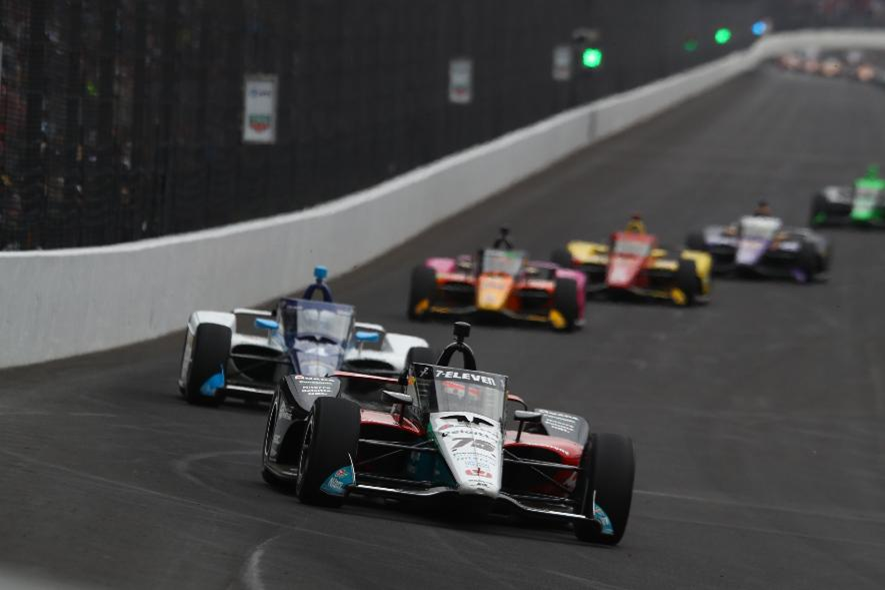
Takuma Sato returned to the 108th Indy 500 with Rahal Letterman Lanigan Racing on a spot participation base. It was the first time for him to compete only one race throughout the season since moving to the IndyCar Series in 2010. Despite the lack of preparation time due to destructive weather, he qualified 10th position. The race started 5 hours late due to a strong thunderstorm and finished in the twilight. Despite the sever condition they were put in, they fought well and finished in 14th place.

▲INDY500, Indianapolis
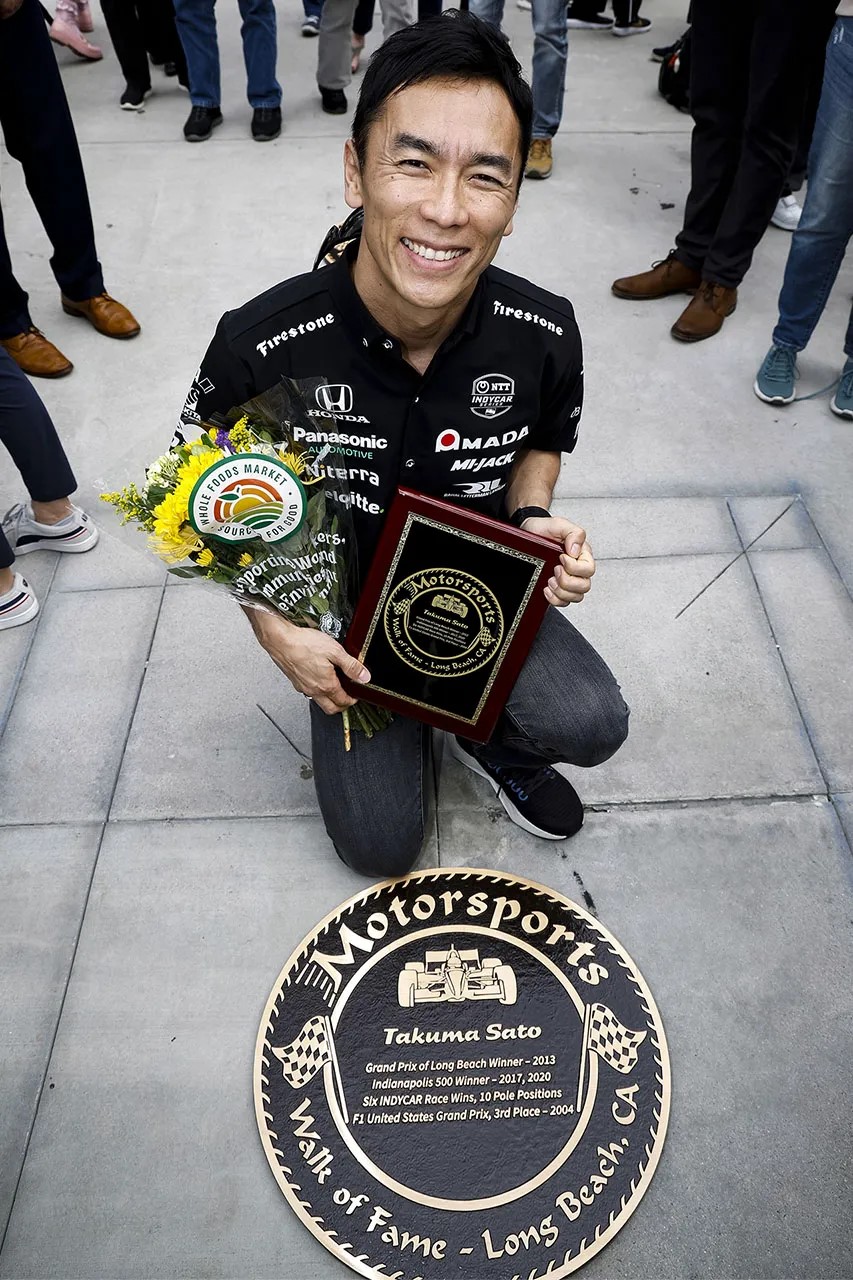
Other activities and awards include a new appointment as an executive advisor to Honda Racing Corporation (HRC) in February and joining the Long Beach Motorsports Hall of Fame as Sato won the first race of his IndyCar Series career in the Grand Prix of Long Beach in 2013 and became the first Japanese-born driver to win an IndyCar Series race.

▲Long Beach Motorsports Walk of Fame
2025
Once again, Sato’s racing season was focused exclusively on the Indy 500. In March, his entry with his former team, Rahal Letterman Lanigan Racing (RLL), was officially confirmed. Expectations for a "third Indy 500 victory" reached an all-time high.
However, the road to Indy 500 was far from smooth. Since July 2024, the IndyCar Series had mandated hybrid systems—a technology Sato, as a single-race entrant, had never experienced. Consequently, the open test held on April 23 and 24 served as his first encounter with the hybrid-equipped machine. The added weight and altered balance of the system made car setup extremely difficult. While Sato managed the 3rd fastest time on the first day, he suddenly lost rear grip on the Day 2 and slammed into the barrier. The impact measured a staggering 94G, leaving Sato with fractured ribs.
The crash totaled the car, seemingly ending his chances of competing. Ordinarily, this would have forced a withdrawal; however, the team’s top management made the extraordinary decision to immediately order a brand-new chassis to keep Sato’s program alive—a move virtually unheard of for a sport entry. Furthermore, while building an Indy 500-spec car typically takes three months, the mechanics worked tirelessly through their holidays, completing the build in just three weeks to ensure the car was ready for practice.
During the practice sessions held from May 13 to 17, progress was stalled by minor mechanical issues. As a result, Sato completed the six-day practice period without having performed a single "four-lap qualifying simulation"—a situation that would normally be considered hopeless. Furthermore, having totaled the car in April, there was absolutely no room for error. Despite being pushed to the limit, Sato refused to give up. He opted for a setup that "wouldn't fall into being too conservative, yet allowed for pushing to the absolute max," and headed into qualifying.
This bold strategy paid off brilliantly. After marking the 9th fastest time on the first day of qualifying, he advanced through the Top 12 in 6th place. In the final "Fast Six" shootout to determine the top of the grid, he stunned the field by securing 2nd place. This marked the first front-row start of Sato's storied Indy 500 career. A decisive factor in this breakthrough was his use of manual energy regeneration during the qualifying runs. While the hybrid system offers an automatic mode, Sato chose to manually operate the regeneration to extract every ounce of performance. While his rivals avoided this due to the high risk of failure, Sato was the only driver to master this extraordinary technique under pressure, ultimately earning him the second spot on the starting grid.
▲INDY500 Qualifications, Indianapolis
For the race, Sato and the team once again refused to play it safe. They opted for a bold setup, aggressively trimming away downforce. From the early stages of the race, Sato surged to the front with ease and began to command the field. His performance was bolstered by flawless execution from the crew; despite two pit stops, Sato maintained his lead each time. Running without a single apparent weakness, he continued to click off laps at the head of the pack. However, during the third pit stop, Sato overran his designated box by about 1.5 meters. This error caused him to plummet to around 17th place. Despite a relentless effort to fight his way back, the deficit was too much to overcome, and Sato crossed the finish line of the 109th Indianapolis 500 in 9th place.
▲INDY500 , Indianapolis
Despite the result, the momentum Sato built
from qualifying through the race made one thing clear: the partnership between
Takuma Sato and RLL remains a formidable contender for an Indy 500 victory.